Showing posts with label Kenya. Show all posts

Tuesday, 27 July 2010

From Moyale


In the dust and the searing heat I feel very far away. I am in Isiolo and must stock up for the ride north. I will carry 15 litres of water and enough food for three days. I buy chewing tobacco to give to Samburu on the road. I am told if they are aggressive the tobacco will make them happy. They cannot get it up there. I wander amongst the narrow rows of dust and stones, through collapsing wooden stands, past old men sitting on low wooden stools playing a game with dried beans. Sudden gusts of wind rouse the sullen grains of sand into momentary frenzy and the old men wrap their shemaghs tightly around their beards. The remnants of black plastic bags quiver like charred flags in the thorny branches of leafless trees. I am staying at the most expensive hotel here and the yard is full of white Land Cruisers with sky blue UN markings branded on the bonnets.

As I ride out of town the shimmering rim of the eastern sun blazes low between the silhouettes of two distant Acacias and the first rays of yellow light flash across the flat scrubland. I am stopped at a police post on the edge of town and told it is better to take a truck. The guard walks around the bicycle and looks curiously at me. He asks if I have a weapon. He lets me pass.

The road is empty and on the new tar, with the wind behind me, I ride quickly. Large swathes of the dry copper earth lie bare and the sun glints off the corrugated roofs of small clusters of rectangular houses. To the west a bank of purple rock bridges the scrub and a low pool of receding grey clouds. Soon I am crossing the Ewaso Nyiro River and am at the town of Archer’s Post. The police here tell me there has been no sign of trouble for some days. The guard points to two hills in the distance and tells me to be carful here. Bandits hide in the bush there and make ambush. Even the MP for the area, he has been attacked between these two hills.


Out of Archer’s Post the tar stretches straight for miles ahead and disappears in the vast orange flats. Ostrich on the road quicken their pace as I approach and scatter powerfully across the sand as I pass. Dic-dic stand alert in the dry bush and a lone eagle rises and falls with the currents of the empty sky. I ride on and pass two large mounds of bare stone that looked so small in the distance from Archer’s Post. I hear the faint hum of an approaching vehicle breach the desert silence. A man on a motorbike passes and waves. He has a rifle slung across his chest. It is hot now, and even with the wind behind me, the sweat is pouring from my forid as I stare at the waves of heat rising from the black tar.


By mid morning I am riding across a rough dusty stretch through a village. Small stone huts and rickety shelters made of tangled branches line the road. Samburu warriors walk bare-chested in twos and threes, marking each stride by pressing their spears into the dust. They turn as I pass and stare silently at me. I smile and stare back. They wear bright robes from the waist down and sandals made from tyres on their feet. Each man has a dagger sheathed in red leather strapped to his thigh. A chain of golden beads runs from large wooden earings that hang heavily from each lobe and passes across their faces between the nose and mouth. Some are bare-headed, others wear helmets with bright red plumes the shape of mohicans running from their foreheads to the back of their necks.


Women in long red and blue robes with rows and rows of beads, hanging from their necks to their breasts, carry buckets of water to their huts. Scruffy kids in torn shorts, with anklets tied loosely above bare feet, peek at me from the safety of their huts and disappear shyly as I wave. There are soldiers in green camouflage ambling up the road holding worn rifles and goats searching for scraps in the dust.


A man runs into the road in front and tells me I must not continue. He says between here and Laisamis the road is very dangerous. He says a Chinese road worker was shot just 6km from here. He says an American cyclist was assaulted between here and Merille. They didn’t steal anything from him, but they broke both his thumbs and smashed his shoulder. The sun is scorching now and I take a long gulp of water. I wheel my bike into the shade and light a cigarette. ‘You will wait here for a truck. It is better.’ I feel sad and try to summon the will to continue, but guilt, when I think of home, and dread, swallow my faltering courage.


A tall woman in long white robes comes out of her house and nods and smiles. She tells me they do not often get visitors here. ‘We like visitors. You stay as long as you need.’ Her daughter brings me a bowl of beans and ugali and sits in silence as I eat. She smiles when I finish the plate and asks if she may give me a thing. A necklace of multi-coloured beads slips from her fingers and she stands on tip-toes and ties it round my neck.


I sit for hours waiting for a truck, but none pass. The children gradually get used to me and poke at my beard and laugh and stare at the bicycle in wonder. Night falls and I drift into sleep on an old sofa, amidst the low murmurs of those sitting around me. I am woken in the middle of the night and told a truck is outside. It is all very rushed and I am ushered through the darkness and hoisted onto the open back of a metal framed lorry. There is an old Muslim lady wrapped in a rug on top of the crates and a man with an AK47 keeping watch on the front. Soon I am hurtling through the night towards Moyale with a hundred crates of beer beneath me, staring up at all the stars of the desert sky.


Monday, 26 July 2010

From Isiolo


As I leave Malaba, heading north-east, the prospect of what I will do when I reach Isiolo begins to dominate my thoughts. Since the start of the journey, four months ago, the road north from Isiolo to Ethiopia has been a distant, but impossible stretch. I have met many cyclists along the way; none of whom attempted it. I have been warned, and warned again, this stretch is rough. Do not try to ride it. Trucks travel in armed convoy. Bandits roam the desert scrub. Many have died on the road. Somalis, AK47s, warring tribes, 50 degree temperatures, 530 km of rock and dust stretching out into a violent wilderness. Now the road draws near the warnings grow louder and my desire to try stronger.

As I leave Malaba, I am still 620 km from Isiolo, and I am beginning the slow climb back across the Rift Valley. I ride 140km to Eldoret, over hill after hill, past the same maize, the same huts, on the same rutted tar. It is a different road to the one I took to Uganda, but I feel as if I have covered it before, and as the climb saps my strength, I stare blankly at the slow-passing landscape with growing weariness. The villages, the waving children, the great swathes of hillside carpeted in crops, would have filled me with wonder a time ago. But familiarity has drawn a grey curtain over the land and now I ride blindly back towards the east.

By early afternoon the sun is hot and I feel the energy of a storm growing in the surrounding air. Ahead a wall of blue cloud bruises the eastern skyline and thunder begins to roll across the hills. It is like riding into the night as I approach the darkening skies with the scorching sun still burning my back. Soon heavy droplets are falling like pebbles from the sky and I rush to the shelter of a little highway town. Within an hour the sky lightens and I ride onto Eldoret.

I stay at a guesthouse with smashed windows and take a bath in a bucket. In the evening I take a walk and pass a young boy digging for treasure in a junk-filled skip. A young mother sits slumped on the cracked pavement and stares at me with angry eyes. Her hands join together to beg and her eyes have lost all hope. I pass hustlers, and alley cats, and young men leaning lazily on Chinese scooters, and all the sidewalk skanks. From the shadows a man whispers: ‘Jesus, is that you?’ I laugh and he smiles and disappears down a smoky passageway. It was here, in Eldoret, three years ago, where bitterness over the election became violent. Thirty women and children were burnt alive in a church, and men slashed each other to death in the streets.

From Eldoret I ride 155km to Nakuru, climbing again, senselessly. As I descend for miles towards the valley floor, past Candelabras and Acacias, the thrill of the ride returns. After Nakuru I head north to Nyahururu, and onto Nyeri, and Timau. I cross the equator, and the last of the long Rift Valley ascents, and isolated wooden shacks in the golden grasses of Adebare plateau. At Nyeri I join the Great North Road and cycle through crisp highland air, passing the twin peaks of Mount Kenya in the east. I pull into a campsite just north of Timau and pitch my tent amongst Wild Olive trees and tall Cedars. I am only 65 km from Isiolo.

I go to speak to the lodge owner, Mr Wason, about the road north. He is sitting in a wicker chair on his porch, wispy grey hairs sprout from his open-necked shirt, and both his thumbs are hinged behind his braces. He invites me to sit and his wife brings me a cup of chai. I tell him about my journey and what I have heard of the road north. He nods, and strokes his chin, and rocks gently in his chair. He says the road is very bad. He says cyclists take trucks for this section. He says I should try. ‘Why fear? Never let fear decide.’ He pauses. ‘How do you want to die?’ I look startled and he smiles and says back in Afghanistan that is how we talk. ‘Do not fear death. We will all die.’ He tells me how years ago two people walked the road. They were fine. He tells me how, in the fifties, his brother hitchhiked there, across the frontier territories. His brother was picked up by a British army truck, who told him a nearby tribe would cut off his nuts and hang them from his neck if they found him.

He lists villages along the road and says I must camp at the police posts there. With each village name he tells a story from the old days. ‘After Serolevi, you will reach Merille. I was there in seventies, hunting lion, you know. Indeed just west of there I came across an elephant stuck in a swamp. I walked into the mud and tied a rope across its belly. Now, the elephant it knew. It knew I was trying to help. When I was beneath it, it moved its trunk very slowly towards me and sniffed. It just sniffed. It knew I meant it no harm. For two days we tried to pull it out, but it was no good, it was sinking. There was a crowd of 500 around waiting for it to die. After two days we gave up, it was suffering, you know. So we had to shoot. Before we shot I went up to the elephant, very close. And I saw tears coming from its eyes. It was crying. It knew we had given up.’ He sighs. ‘I couldn’t take the shot and from that moment I never shot another elephant.’

‘…. And then to Laisamis, yes, Laisamis. My good friend, a vet, he was speared by a rhino near Laisamis. He would have died if we hadn’t had my 4x4.’ He tells me story after story: lion, Samburu, deserts, guardian angels. As he talks I feel the apprehension drain begin to drain from me and the will to try, and to trust those I meet along the way, begin to grow. As I get up to go he gives me the names of men in Marsabit and Moyale: ‘the most powerful men in the towns: If you have any troubles, you will call them and mention my name. They will help you.’

The next morning I zoom from the highlands into the oncoming desert. It takes me only two and a half hours to ride the 65 km to Isiolo, and soon the land is golden and the grass has turned to dust. Ahead the desert rolls out before me and I am on the fringes of a great wilderness, staring out at vast ochre plains and mounds of far-off black rock, burning beneath the scorching crimson sun.

Wednesday, 23 June 2010

From Chogoria


My bicycle is in Nairobi and my passport in London and I am in the back of a dalla dalla on the way to the foot of Mount Kenya. We race across the hills, past towns and fields and rivers, and I want to stop and look at all, but we are already past and through the little plastic window it is all tinged with grey. I am with David, who will guide me up the mountain, and we arrive in Nanyuki, from where we will start the trek, in the afternoon. We get a plate of barbecued mutton and ugali in a huge diner and people shout out countries at me as I walk through the tables: Guatemala, Israel, Spain. On the road outside a British Army van passes and David tells me there is a base nearby. He says the soldiers do good for the town. He says at weekends the soldiers come in from the bush, and have beers, and make African babies.

In the morning we set off early and walk up a rocky 4 x 4 track that climbs gently through the grassy foothills. A dense fog covers the hilltops and the gangly stalks of giant heather, bald and singed black by a forest fire, rise statically from the swaying elephant grasses. As we get higher we clamber across rocky streams, crisp water bubbling just below our boots. I kneel down and drink from my hands. We stop at a hut after hiking 9 km and boil a chicken which we eat with fried onion and carrot.

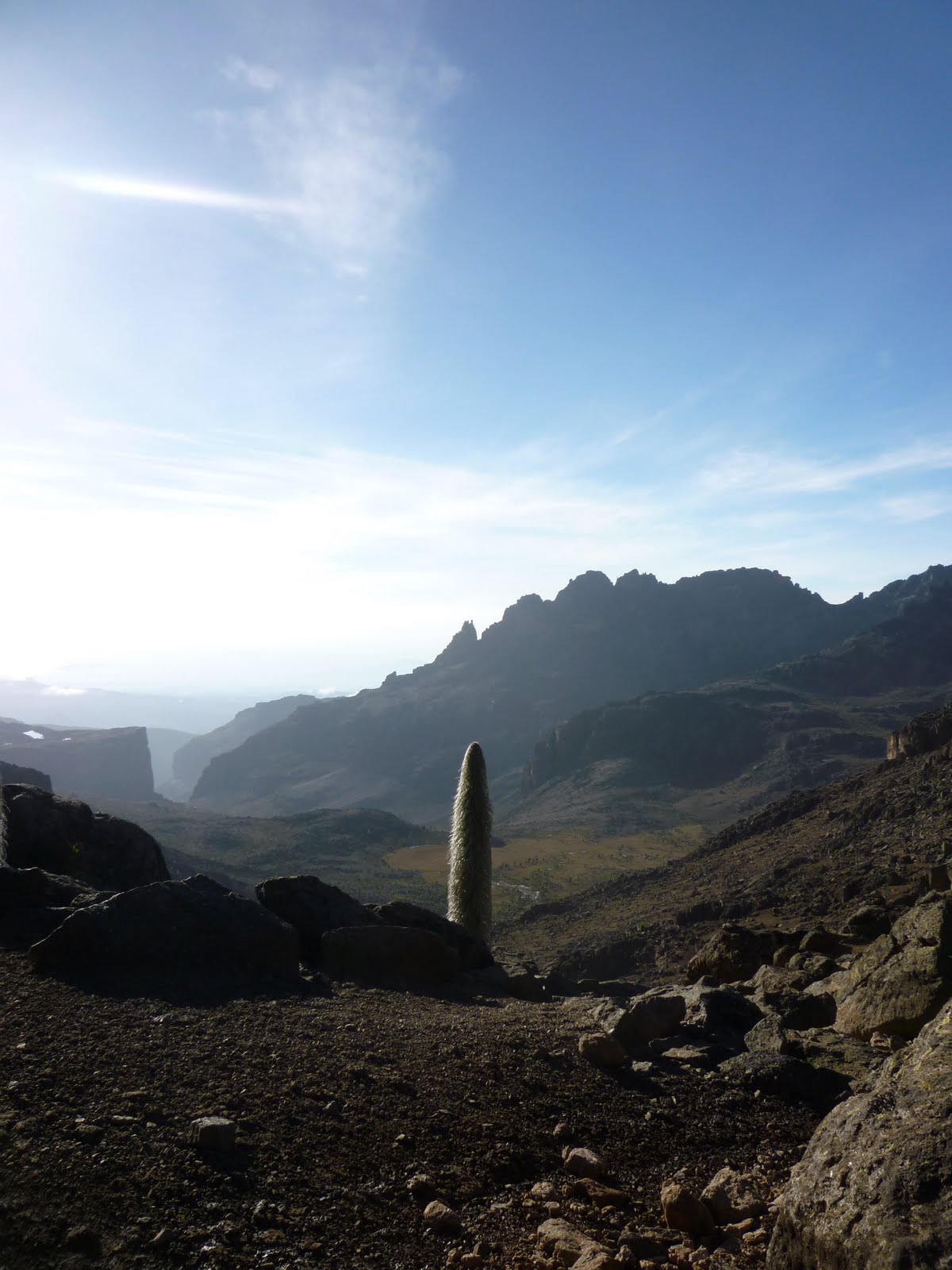
We are up before sunrise and follow a thin path over the thick spines of swelling ridges and walk down into soft valleys carpeted in damp yellow moss that squelches beneath our feet. The sky is very clear and currents of cool air sweep across the valley floor making the feathers of the tall lobelia plants shiver in the pale sunlight. We take a rest by a stream and I look up and watch the fickle mountain mists drift apart to reveal the towering spires of the summit brushing against the crystal sky far ahead. Huge swathes of the slopes just below the peak have given way leaving a frail membrane of scree trickling towards the valley. As we get higher the grasses disappear and we make our way through barren slopes of dust. Mountain rats and rock hyraxes scuttle amongst the pebbles and rosette flowered lobelia stick out of the rocky ground like triffids on a martian moon.

We reach the hut where we will sleep long before dark and sit around a barrel of burning wood clutching streaming cups of tea. By dusk frail flakes of snow crowd the icy air and a veil of fog has fallen on the twin peaks above us. The vague form of the mountain top looms heavily in the gloomy sky; a great mass of volcanic rock peering out from the mist like a lost cathedral. David tells me how the people who lived at the base of the mountain believed the mountain to be a God. When there was no rain the elders would walk to this point and pray. When they came down the rain would come.

We wake at three to make the summit by sunrise. It is bitterly cold when David and I begin the final 3 km ascent. We clamber up the scree, slipping, and then grasping for solid rock, guided by the faint light of our head-torches. Above shooting stars drop from the sky like pieces of crumbling candy. We take regular breaks and lean against boulders, breathless. As we get higher the air thins and the darkness begins to recede, unmasking the hazy silhouette of the approaching summit. Soon we are scrambling up the final few metres of frosted rock and I am looking out at the young sun igniting the eastern sky in a thin field of ochre light. I look down from the mass of jagged brown rock at boulders and dust cascading towards an enormous tide of thick white cloud. There is a glacier sitting in a hollow to the south and crater lakes reflecting the brightening sky scattered amongst the crumbling slopes beneath us. David is sitting quietly on a rock, with a faint smile on his face, watching me try to take it all in.

On the way down we slip on the scree and I try to run down the steep bits and lose my balance and then tread timidly until the slope begins to flatten. We pass calm green lakes that from the peak shimmered like little pearls, half buried in the rubble, but now we see them wide and deep. We stop and share a bar of chocolate that I saved and have a smoke with the sun warming our faces. As we descend further the lobelia begin to sprout from the rocks and soon they are all around us. The ground is soft and murky yellow now and thin streams of water trickle quietly through the boggy soil. Two tall shoulders of rock rise sharply on either side of the gorge ahead, swallowing the falling green valley in darkness. We follow the lip of the gorge on the eastern side and I stare over the edge at the valley dropping abruptly and a torrent of water cascading over the rocky crest towards the grassy floor.

My legs are tired now and David is limping; we trudge slowly through the heather with our packs, like two hobbits in an empty world. The wind is picking up and I stop to take a photograph of a small red flower clinging to the craggy cliff edge. I wonder if it will blow off and where the little red petals would carry to in the wind. We have been walking for ten hours now and my feet are sore. I bought my boots second hand at a market in the slums and they are wearing the skin off my heels. I am happy to sit down when we stop for lunch and we build a little fire and boil a pot of noddles and some tea. We lie back with our heads resting on our packs, blowing smoke into the air. I ask David about his life in Nairobi. He says he lives in a single room with his wife and son. He has electricity, but life is hard. He says some people in Nairobi are very rich. There are even men who pay $500 to stay in a hotel. Just for one night. And in coffee shops in the city people pay $2 for a little cup of coffee. He shakes his head in disbelief.

We eat and get up wearily and walk for another few hours to camp, where we sleep, exhausted. The next morning we hike the final 20 km to Chogoria. We walk through a bamboo forest; the glare from the low sun filters through the crowded spines of wood, splintering shards of bright light across the path ahead. Elephants have trampled many of the trees and the narrow stalks lie crushed on the path. We stop to look at some leopard tracks, stooping over the shallow imprints, and tracing little circles in the dust with twigs. David tells me how the Masai carry the dying into the forests near here. When people are very sick they are led here and left for three days. If they are still alive after that time they are taken back to the village. But there are many wild animals in the forests. They will eat the dying. We emerge from the forest and out into fields of tea and coffee and pineapples sown into steep green slopes. There are women with baskets slung over their backs picking there way through the crops and more and more people everywhere as we arrive in Chogoria.

Sunday, 13 June 2010

From Nairobi


Leaving Moshi the sky is dull. Light rain trickles from the heavy clouds and all around the land is swamped is grey. It is Sunday and the roads are quiet; the little highway towns waking slowly as I pass. A dense fog hangs stubbornly in the still air, hiding Kilimanjaro and a hundred beautiful views behind a drab curtain of impenetrable mist. I slip into a daze and soon I am nearing Arusha. From a village just out of town a long procession snakes its way slowly across the road. There are young kids at the front clapping and swaying, shuffling to slow rhythm of the march. Behind nuns in blue habits shepherd them along and women in their Sunday best sing hymns which carry through the crowd and drift into the surrounding fields. I stop to let the long line cross the highway before riding onto Arusha. The town is bigger than I had expected and hustlers chase me through the streets shouting about safaris and best-deal-hotels.
From Arusha it is 120 km to the Kenyan border. The road is being re-tarred and a relentless wind drives thick clouds of dirt across the rough track. The dust clings to the grasses and bushes to my left smothering them in a lifeless carpet of ashen dirt. To my right Chinese workers wearing clean white masks sit in rollers preparing the new highway. On the sections of completed road I speed along the smooth surface through the silent dry plains. I can see Masai roaming through the wilderness with great herds of horned cattle. Lonely Acacias and Buffalo Thorns stand out on the horizon and above it all Kilimanjaro looms above the clouds like a giant from another world.

As I near the border a Masai stops me and asks for a dollar. He looks a great warrior holding his spear, his beautiful robes billowing in the wild wind. It makes me sad that he asks. I camp over the border and head north on the road to Nairobi the next day. The air is cold and damp and all around the lowland slopes are covered in empty Savannah grasses. I ride quickly, using the momentum from each downward slope to propel me over the next. As I rise over the shallow lip of another small hill I see a dalla-dalla reversing towards me. We are already close and the little bus is still reversing. The driver hasn’t seen me and it is too late now. I swerve to the right as far as I can and the back smacks my leg and I fall to the ground.

I stand up and look at the saddlebags strewn across the roadside and the bike lying calmly on the gravel. I turn and stare at the bus still slowly reversing. It is packed with bewildered faces staring at the lunatic beginning to run towards them. Blood is streaming from my leg and I am screaming at the driver. He slowly stops and I wrench his door open and haul him from his seat. I cannot believe he didn’t stop. That he was reversing that fast. That my bike might be bust. I am pinning him against the bus and shouting in his face. He keeps saying sorry, that he didn’t see.

There are people all around us now telling me to calm down; kind eyes and peaceful hands trying to cool the spoilt rage of the melodramatic Muzungu. Kind eyes saying accidents happen. The bike can be fixed. The driver didn’t mean it. And above, all worse things happen. I look around at the corrugated shacks that line this section of the road. I feel ashamed. I step back and walk over to my bike. The back wheel won’t turn and the the frame is bent. I take out an allen key and begin to adjust the brakes and realign the wheel. Everyone is trying to help, bashing the frame back into shape, and after half an hour the wheel is turning again and I pedal off northwards.

I spend the night in a little Muslim guesthouse in Kajiado. It is the World Cup and I watch the England game with the owner, drinking sugary tea. From Kajaido it is only 80 km to Nairobi and by mid morning I am riding on a three lane highway past tall mirrored buildings and outlet stores and billboards advertising financial solutions. There are women in high heels and pencil skirts talking on mobiles and new Mercedes Benzes speeding towards the skyscrapers on the horizon. I head downtown and find a backpackers.

I go to the Ethiopian Embassy the next day to get my visa. I am sitting in a little waiting room when I hear a call to get in. There is a man sitting behind a desk with his arms folded across his tie. I hand him my passport and begin to explain my journey. He tells me it is not possible to get a visa. I must fly to Addis and get one at the airport. I explain that I have ridden a bicycle from Cape Town, riding every mile. He says it is not possible to get a visa. I must fly to Addis and get one at the airport. I stare at the flag on his desk and think that there is always a flag nearby in these situations. I mumble that I don’t understand and he looks at me sternly and tells me it is not for me to understand. That is the Ethiopian Regulations. They make sense. He tells me to get out. I wander back towards my hostel down a long avenue of high-walled compounds, wondering what to do. I decide to send my passport to London and get an agency to arrange the visa from there. It means two weeks in Nairobi. It is a fun city and I will climb Mount Kenya while I wait.