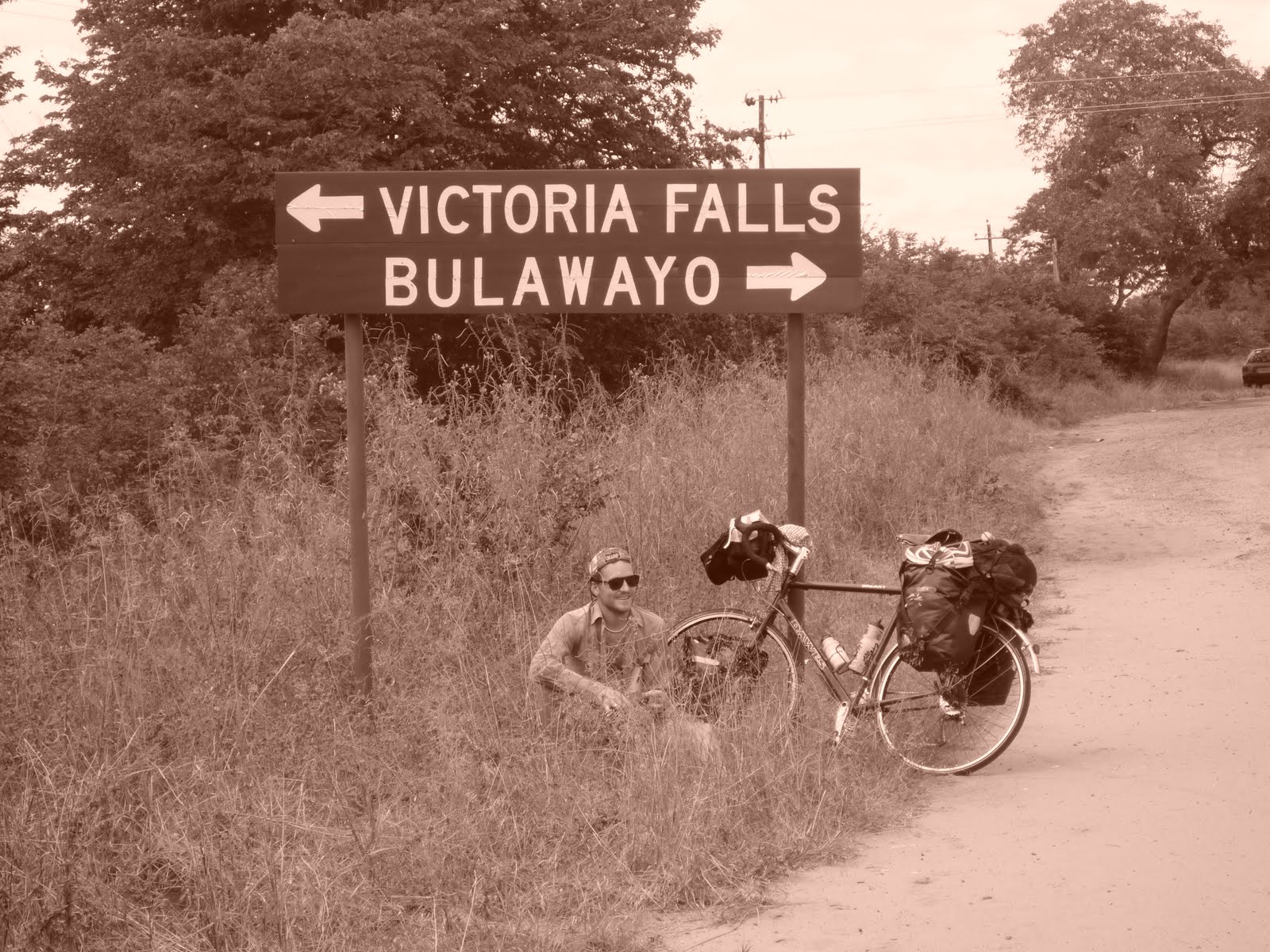
Guy and I set off along the flat highway out of Livingstone into the open bush and big blue sky at an easy pace. We have enough food to last a few days and little idea of what lies ahead. As the air around us heats up we come to a section of the road that is being re-tarred and must ride a dirt road parallel. Each time a car passes it kicks up a cloud of orange sediment that sits in the still air ahead, choking us as we rattle into the dust. We push our bikes through the trees to our right, back on to the newly laid tar and see the tracks of our wheels leave two long straight lines stretching back through the soft black road behind. While we stop to eat in the shade, a van passes sprinkling water to set the tar. We run under the spray and take a cool shower under the midday sun.
We ride on through the afternoon past conical huts with straw roofs that jut out from the clumps of green acacia bushes and dry yellow grasses that line the road. At four, we turn off down a thin path which winds past small plots of maize and sweet potatoes, opening out onto a dusty yard in the middle of five small huts. Three women are sitting on short wooden stools sieving ground nuts under a mophane tree. They bring us a purple cushioned stool each to sit on and are happy for us to camp here. There is a rainbow arching faintly in the sky above the largest rectangular hut and I get up to try to photograph the shadow my body casts on the hut’s sandy walls. As the sky pales and the thin white crescent of the moon becomes visible above the pink clouds to the east we cut wood and pull our stools around the fire.
One of the younger women, Rose, speaks English and asks about life in our place, where we come from. We tell her we are from London and she turns her head to the north and says, ummm.. oooh.. from that side.. and what is it like there? Do you live on farms, that side? We tell her we buy our food from shops and live in houses made of bricks. Oooh.. And do have a car, on that side? We tell her most people do, but we prefer to ride our bicycles. Oooh.. yes.. ummm.. on bicycles, you do prefer, by your own legs.. She nods and smiles and adds some more maize to the pot of boiling water. Gradually kids of various ages approach out of the dusk and perch beside us around the fire. They stare at us and whisper quietly to one another. We smile at them and slowly say our names and they look startled and search for Rose’s eyes across the low flames.
When the food is ready we each wash our hands in a bowl of water and share nshima which we dip in a paste made from ground nuts. It is very dark now and the sky is clear. Rose tilts her head back and tells us that here, this side, they do often enjoy to look up at the stars. We all stare upwards and I tell her that where we live the stars have been turned black by the lights in peoples’ houses.
The next morning we wake to a rooster calling loudly just outside our tents and set off early, heading for Choma, a town 120 km north. The road is flanked by little corn fields and small huts and waving children, calling out as we pass. We check into a motel in town and get an early night ready to ride 200 km the following day.
We wake to pouring rain and set off under heavy black clouds. As we leave town the road rise gently onto a low plateau above valleys of fertile green forest on both sides. To the east the escarpment on the western fringe of Lake Kariba is just visible through the thick grey air. After a few hours of riding in steady rain, the clouds begin to hail and I can barely make out the headlights of oncoming cars not twenty feet ahead. The hail ricashaes off the road and the tar is flooded with thin torrents of water that rush towards the muddy verge. The sand roads off the highway have turned dark brown and the rivets on the tracks are filled with puddles of murky water. We ride on past small towns made up of single rows of dilapidated buildings with faded facades offering butchers, spices, investment services, and groceries. At half past ten we stop at Monze for a cup of tea, having covered 100 km in four hours. As the clouds lighten and the rain subsides the road through Monze begins to fill up with rickety bicycles, carrying logs and bleating goats, and women wandering to market in brightly coloured sarongs with babies tied snuggly to their backs.
After a long break we set off again and the ride begins to wear me down. The road undulates over rolling hills and my legs are weary even on the shallow climbs. It is getting late and the roadside is fenced on both sides; there is nowhere to camp. Eventually we turn off down a muddy track onto a cattle ranch. The mud on the road down to the farm is thick and our wheels churn slowly and sink to a halt, refusing to turn. Guy falls and we are both exhausted and our bikes are soon covered in the thick red earth. The workers say it is ok to camp and we trudge back up to the track and pitch our tents in the dark. Guy cooks us both noddles and beans and we go to bed wet and tired, but knowing we will reach Lusaka the next day. We leave at first light and climb over the Mantumi Hills, across the Kafue River, into the heavy Lusaka traffic. The sun is bright and it is a good feeling to weave our way through the busy city streets, having ridden 550 km since leaving Livingstone four days ago.